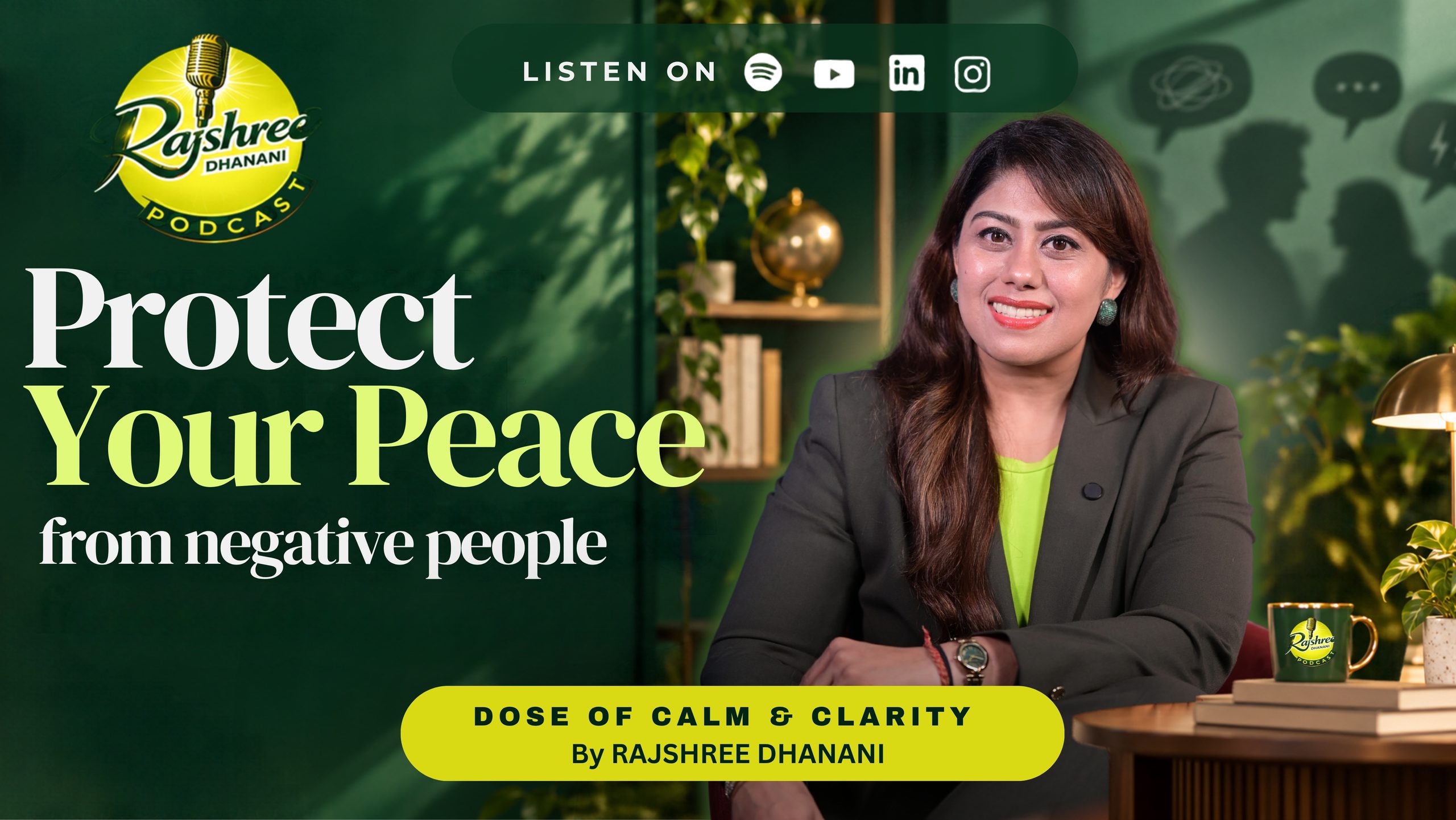
Protect your peace from negative people before their emotions start becoming your own.
Have you ever noticed how one conversation can completely change your mood?
You were feeling absolutely fine. Then you met someone, spoke to them for a few minutes, and suddenly you started feeling irritated, doubtful, insecure, restless or emotionally drained.
Nothing dramatic may have happened. There may have been no argument, no confrontation and no obvious reason for the sudden change.
Yet something inside you feels different.
That feeling deserves your attention.
In this Dose of Calm & Clarity, Rajshree Dhanani explores an important question:
Why do we allow someone else’s emotions to become ours?
The answer begins with something simple but powerful: awareness.
Before trying to change another person, we first need to notice what is happening inside us.
7 Practical Ways to Stay Calm Around Negative People
The first step to protect your peace from negative people is becoming aware of the emotional effect certain conversations have on you.
It is easy to focus entirely on what another person said or did. But sometimes the more useful question is:
How did I feel before this interaction, and how do I feel now?
That comparison can reveal patterns you may otherwise ignore.
Ask yourself:
- Do I feel drained after meeting this person?
- Do I suddenly become angry or restless?
- Do I start doubting myself?
- Do I feel insecure after certain conversations?
- Do our discussions repeatedly turn into gossip?
- Does every conversation become an argument?
- Do I carry their negativity for the rest of my day?
These emotional changes do not automatically mean that another person is bad.
They simply give you information about how an interaction is affecting you.
And awareness gives you an opportunity to choose your response.
1. Become Aware of Your Emotional State
The first solution is awareness.
When we are emotionally triggered, our instinct is often to react immediately.
Someone says something irritating, and we answer back.
Someone complains, and we start feeling frustrated.
Someone becomes anxious, and suddenly we become anxious too.
But before reacting, pause.
Observe what changed inside you.
Ask yourself:
“Was I feeling this way before I met this person?”
If the answer is no, that emotional shift may be worth understanding.
Emotional awareness allows you to recognise what you are experiencing without immediately becoming controlled by it.
That small pause can completely change how you respond.
2. Notice the Signs of Negative Emotional Patterns
Sometimes one uncomfortable conversation means very little.
Everyone experiences stress.
Everyone has difficult days.
But repeated patterns deserve attention.
You may need stronger emotional boundaries when you repeatedly notice:
- Feeling exhausted after talking to someone
- Feeling anxious before meeting them
- Constant criticism or complaining
- Repeated gossip about other people
- Arguments that never reach any resolution
- Feeling responsible for another person’s mood
- Feeling insecure or doubtful after conversations
- Replaying the interaction in your mind for hours
The purpose of recognising these signs is not to label people.
It is to understand what repeatedly affects your emotional wellbeing.
3. Pause Before You React
Your feelings can be a signal.
But they do not always need to become an immediate reaction.
When a conversation starts affecting you, pause before responding.
Ask:
“Do I really need to respond to this?”
“Will continuing this conversation create clarity?”
“Am I responding calmly, or am I simply reacting emotionally?”
Not every comment deserves an answer.
Not every disagreement requires a defence.
Not every misunderstanding has to become an argument.
Sometimes protecting your peace means giving yourself a few seconds before deciding what deserves your energy.
4. Don’t Try to Change the Person
One of the easiest ways to become emotionally exhausted is constantly trying to change another person.
You explain.
You repeat yourself.
You try to convince them.
You try to make them understand your perspective.
You believe that if you explain yourself one more time, perhaps everything will change.
But the truth is simple:
You cannot control everyone around you.
You cannot control how another person thinks.
You cannot force someone to understand your perspective.
You cannot decide how another person chooses to communicate.
What you can control is your own response.
Instead of asking:
“How can I change this person?”
Ask:
“How should I respond to this person?”
That shift takes the focus away from controlling someone else and brings it back to your own emotional clarity.
5. Don’t Argue About Everything
There is a difference between a healthy discussion and an endless argument.
A productive conversation creates understanding.
An unproductive argument often repeats the same points with increasing frustration.
Not every disagreement needs another explanation.
Not every opinion needs to be corrected.
And you do not always need to have the final word.
Sometimes the healthiest response is:
“I don’t want to continue this conversation.”
Knowing when to stop arguing is not weakness.
It can be a form of emotional discipline.
Your peace does not have to depend on winning every disagreement.
6. Don’t Absorb Someone Else’s Mood
This is one of the most important lessons when learning how to protect your peace from negative people.
Someone else’s anger does not automatically have to become your anger.
Someone else’s anxiety does not need to become your anxiety.
Someone else’s insecurity does not need to become your insecurity.
Someone else’s negativity does not need to become your mindset.
You can acknowledge another person’s emotions without carrying those emotions with you.
Think about it this way:
Someone may be carrying a heavy emotional bag.
You can see that they are struggling.
You can listen.
You can care.
You can support them.
But you do not necessarily have to pick up their emotional bag and carry it for the rest of your day.
Compassion and emotional absorption are not the same thing.
7. Create Distance and Set Emotional Boundaries
Sometimes awareness alone is not enough.
If an interaction consistently leaves you emotionally exhausted, creating some distance may be necessary.
Distance does not always mean completely removing someone from your life.
It can simply mean:
- Responding less frequently
- Giving yourself time before replying
- Avoiding repetitive arguments
- Changing uncomfortable subjects
- Reducing unnecessary conversations
- Spending less time in draining environments
- Protecting your personal space
Distance creates room for clarity.
When you are constantly reacting to another person’s emotions, everything can feel urgent.
When you create some space, you often begin to see the situation more clearly.
How to Set Boundaries Without Being Rude
Emotional boundaries do not need to be aggressive.
You can communicate them calmly and respectfully.
You might say:
“I don’t want to discuss this.”
“I’d rather not participate in this conversation.”
“Let’s talk about this when we’re calmer.”
“I’m not comfortable with that.”
“I need some space right now.”
A boundary is not about controlling another person.
It is about communicating what you are willing to accept and how you choose to participate.
You do not need anger to set a boundary.
Sometimes clarity is enough.
Respond Less and Protect Your Peace
Sometimes the healthiest thing you can do is respond less.
We often give too much attention to things that do not deserve that amount of emotional energy.
A negative comment becomes a long argument.
A small disagreement becomes hours of overthinking.
One message changes the mood of an entire day.
Responding less helps interrupt that cycle.
This does not mean ignoring important issues.
It means learning to recognise which conversations actually require your attention.
Not everything requires an immediate response.
Not everything requires an explanation.
And not everything deserves access to your peace.
Ask Yourself: “Is This Actually My Emotion?”
This may be one of the most powerful questions you can ask yourself.
Whenever negativity enters your mind, pause and ask:
“Is this actually my emotion—or did I just pick it up from someone else?”
Think about how you were feeling before the conversation.
Maybe you were calm.
Maybe you were focused.
Maybe you were having a good day.
Then one interaction happened.
Suddenly you felt heavy, irritated or doubtful.
Before carrying that emotion into the rest of your day, examine where it came from.
Does it genuinely belong to you?
Or did someone else’s emotional state temporarily influence yours?
Recognising the difference can help you let go of emotions you do not need to continue carrying.
You Cannot Control Everyone Around You
One of the most important lessons in personal growth is accepting the limits of control.
You cannot control:
- Someone else’s attitude
- Someone else’s behaviour
- Someone else’s opinion of you
- Someone else’s jealousy
- Someone else’s anger
- Someone else’s emotional reactions
But you can control:
- How you respond
- How long you remain in the conversation
- Where you set your boundaries
- How much emotional energy you invest
- What you continue carrying after the interaction ends
Trying to control another person can create frustration.
Learning to manage your own response creates clarity.
Protecting Your Peace Does Not Mean Avoiding Everyone
There is an important distinction to understand.
Protecting your peace does not mean avoiding every difficult conversation.
It does not mean disappearing whenever someone disagrees with you.
And it certainly does not mean expecting everyone around you to be positive all the time.
Real relationships include difficult moments.
People experience stress.
Friends may need support.
Families disagree.
Colleagues may have challenging days.
The goal is not to remove every uncomfortable emotion from your life.
The goal is to recognise repeated patterns that consistently affect your emotional wellbeing.
One difficult conversation does not necessarily define a relationship.
Repeated emotional patterns deserve closer attention.
Why Emotional Boundaries Matter
Healthy emotional boundaries help separate your responsibilities from another person’s responsibilities.
You can care about someone without becoming responsible for every emotion they experience.
You can support someone without constantly sacrificing your own emotional wellbeing.
You can listen without agreeing with everything.
You can disagree without turning every difference into a conflict.
Boundaries allow relationships to exist without requiring you to abandon your own peace.
How to Protect Your Peace Every Day
Protecting your peace becomes easier when you practise small habits consistently.
- Notice your emotional state. Pay attention to sudden changes in mood.
- Pause before reacting. Give yourself a moment before responding.
- Recognise repeated patterns. Look beyond one isolated incident.
- Stop trying to control others. Focus on your own response.
- Avoid unnecessary arguments. Not every issue needs another discussion.
- Create healthy distance. Give yourself room when interactions become overwhelming.
- Set clear boundaries. Communicate calmly when something does not feel right.
- Respond less when necessary. Protect your attention.
- Check the emotion. Ask whether it actually belongs to you.
- Return your attention to yourself. Your peace deserves care too.
Be Aware. Be Selective. Be a Blender of Joy.
You cannot prevent negativity from existing.
You cannot control every conversation.
You cannot decide how everyone around you behaves.
But you can become more selective about what you allow to stay inside you.
Choose which conversations deserve your attention.
Choose which opinions deserve space in your mind.
Choose which emotional situations deserve another response.
And whenever your emotional state suddenly changes, ask:
“Is this actually my emotion—or did I just pick it up from someone else?”
Sometimes protecting your peace begins by refusing to carry something that was never yours.
Be aware. Be selective. Be a blender of joy.
This is your Dose of Calm & Clarity.
Watch Dose of Calm & Clarity
Watch Rajshree Dhanani’s Dose of Calm & Clarity reel on emotional awareness, negative energy, healthy boundaries and protecting your peace.
You can also explore more reflections on self-awareness, emotional wellbeing and personal growth through Dose of Calm & Clarity.
Frequently Asked Questions
How do I protect my peace from negative people?
To protect your peace from negative people, begin by recognising how certain interactions affect your mood. Pause before reacting, avoid unnecessary arguments, set emotional boundaries and create healthy distance when repeated interactions leave you drained.
How do I stop absorbing other people’s negative emotions?
Pay attention to sudden changes in your emotional state. Ask whether the emotion existed before the conversation or appeared afterwards. Awareness and healthy emotional boundaries can help you separate another person’s mood from your own.
What are emotional boundaries?
Emotional boundaries are limits that help you protect your emotional wellbeing while maintaining relationships. They allow you to decide what behaviour, conversations and emotional responsibilities you are willing to accept.
Is it okay to distance yourself from negative people?
Healthy distance can be useful when repeated interactions consistently affect your emotional wellbeing. Distance does not always mean ending a relationship; it may simply mean reducing unnecessary conversations or protecting more of your personal time.
What does protecting your peace mean?
Protecting your peace means becoming aware of what influences your emotional state and making conscious choices about your reactions, relationships, boundaries, attention and energy.
Should I avoid every negative person?
No. Everyone experiences stress or difficult emotions. Instead of judging someone based on one interaction, observe repeated patterns and decide whether stronger boundaries are needed.
About Rajshree Dhanani
Rajshree Dhanani is an entrepreneur, podcast host and creator behind the Rajshree Dhanani Podcast.
Through conversations with entrepreneurs, founders, business leaders and experts, the podcast explores journeys, lessons, ideas and experiences that go beyond a short introduction.
Through Dose of Calm & Clarity, Rajshree also shares reflections on emotional awareness, self-growth, personal clarity and everyday experiences that shape the way we think and respond.
Book Your Slot Now
Your expertise deserves more than a short introduction. Give your story a meaningful conversation.
Final Thoughts
Learning how to protect your peace from negative people is not about controlling other people or escaping every difficult conversation.
It is about awareness.
It is about understanding what affects you and deciding what deserves to remain in your emotional space.
You may not be able to change another person’s attitude, behaviour or emotions.
But you can change how you respond.
You can create distance when necessary.
You can set boundaries.
You can stop unnecessary arguments.
And you can choose not to carry emotions that were never yours to begin with.
The next time your mood suddenly changes after speaking with someone, pause and ask:
“Is this actually my emotion—or did I just pick it up from someone else?”
Sometimes clarity begins with one simple question.
Be aware. Be selective. Be a blender of joy.