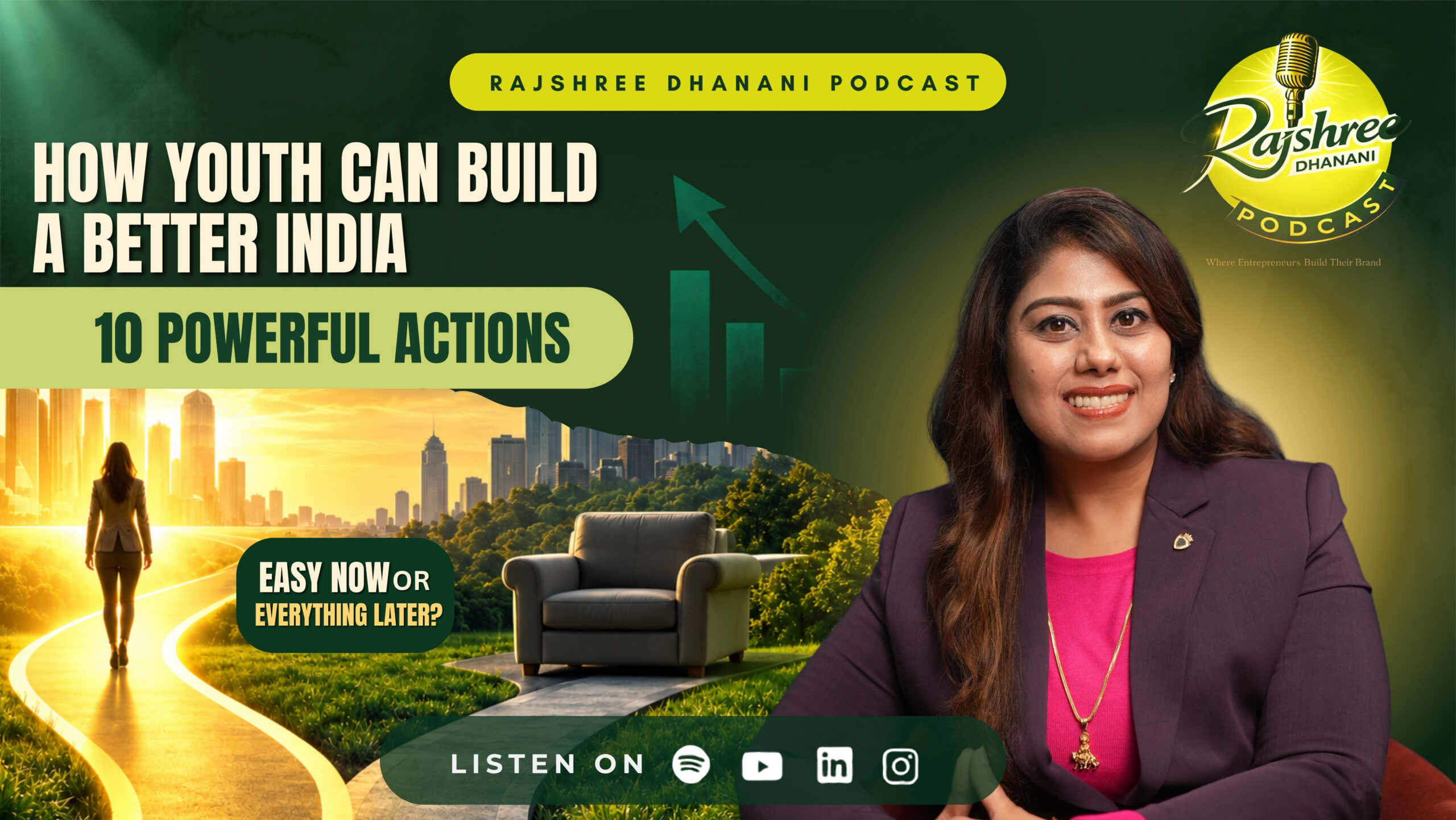
Destruction is easy. Building a better nation takes courage, character, consistency, and action.
India’s future will not be shaped only by policies, technology, or economic growth. It will also be shaped by the everyday decisions of its citizens, especially the younger generation.
How Youth Can Build a Better India begins with a powerful question: Are we simply reacting to the problems around us, or are we taking responsibility for creating solutions?
Social media gives everyone a voice. We can express opinions, question decisions, and highlight important issues within seconds. But meaningful progress demands something more than reactions. It requires learning, cooperation, discipline, and the willingness to contribute.
In a thought-provoking message from Dose of Calm & Clarity, Rajshree Dhanani encourages young Indians to rise above destructive behaviour and use their abilities to create something meaningful.
The message is simple:
Don’t just react. Rise, create, and construct.
Here are ten powerful ways young people can transform this message into action.
Why Youth Power Matters in Nation Building
A nation grows stronger when its people have opportunities to learn, participate, innovate, and contribute to society.
Young people bring energy, creativity, digital awareness, and fresh perspectives. They can question outdated systems, develop new solutions, and inspire positive changes within their communities.
According to UNICEF India’s youth development initiatives, empowering young people through education, employment opportunities, entrepreneurship, and civic participation is an important part of building stronger communities.
However, potential alone does not guarantee progress.
Talent must be developed. Ideas must be tested. Responsibility must accompany freedom. And enthusiasm must become consistent action.
The role of youth in nation building is not limited to becoming successful professionals. It also includes becoming responsible citizens who value human dignity, respect differences, and contribute to the common good.
How Youth Can Build a Better India Through 10 Actions
1. Choose Creation Over Destruction
Destroying something can take moments. Creating something valuable may require months or years of patience and commitment.
It is easy to complain about a broken system, criticise another person’s efforts, or spread negativity when things go wrong.
But constructive thinking asks a different question:
What can I do to improve this situation?
If your neighbourhood has a waste problem, organise a community cleanup. If students lack resources, help develop a learning initiative. If local businesses struggle with technology, share your digital skills.
You do not need to solve every national problem. Begin with one issue you understand.
Constructive action does not mean avoiding criticism or peaceful protest. Raising concerns and demanding accountability are important parts of democratic participation.
The challenge is to turn awareness into practical, responsible progress.
2. Develop Skills That Solve Real Problems
India needs young people who are not only ambitious but also capable of addressing real challenges.
Knowledge becomes especially valuable when it is used to improve lives.
A student who learns digital tools can help a small business reach customers. An engineering graduate can explore safer and more sustainable technologies. A skilled communicator can make important public information easier to understand.
Developing useful skills is a practical contribution to nation building.
Focus on abilities such as:
- Problem-solving and critical thinking
- Communication and teamwork
- Digital and technological literacy
- Financial understanding
- Leadership and emotional intelligence
The goal should not be to collect certificates alone.
Learn something useful. Apply it responsibly. Share what you know.
3. Use Social Media to Inspire, Not Divide
Social media has made public communication more accessible than ever.
A single post can educate, encourage volunteers, promote a meaningful cause, or draw attention to a neglected community issue.
Unfortunately, digital platforms can also spread misinformation, hostility, and unnecessary division.
Before sharing content, ask yourself:
Is this information accurate? Does it help people understand the issue? Am I encouraging a solution or simply increasing anger?
Being a responsible digital citizen means verifying claims, respecting others, and avoiding the humiliation of people with whom you disagree.
Use your online presence to support local achievements, highlight constructive projects, and create thoughtful conversations.
This philosophy also connects with Rajshree Dhanani’s reflection on How to Protect Your Peace from Negative People.
Digital influence becomes more meaningful when it creates understanding rather than confusion.
4. Respect Differences and Choose Humanity
India’s diversity is one of its most distinctive strengths.
People belong to different communities, speak different languages, follow different traditions, and hold different opinions.
Building a better India does not require everyone to think alike.
It requires learning how to coexist with dignity and mutual respect.
Disagreement should not become an excuse for cruelty. Criticising an idea should not mean attacking someone’s identity. Differences should not prevent people from working together on shared problems.
Young people can encourage constructive dialogue in colleges, workplaces, neighbourhoods, and digital communities.
The ability to listen does not mean surrendering your principles.
It means recognising that progress often requires cooperation between people with different perspectives.
Humanity must remain more important than hostility.
5. Turn Education Into Social Contribution
Education should prepare people not only to earn a livelihood but also to understand and improve the world around them.
Imagine a college student spending two hours every weekend helping children improve their reading skills.
Or a young professional mentoring someone preparing for their first job interview.
These actions may appear small, but they create opportunities for individuals who might otherwise lack support.
You can contribute by teaching basic computer skills, sharing career guidance, donating useful learning materials, or volunteering with credible educational organisations.
UNICEF emphasises the importance of equipping young people with opportunities, knowledge, and practical skills to participate in society.
When education is shared, its value extends beyond the individual.
A better India is built when learning becomes an opportunity for more people.
6. Protect Public Spaces and the Environment
Patriotism is not expressed only through national celebrations, slogans, or social media posts.
It can also be demonstrated through everyday responsibility.
Keeping public spaces clean, conserving resources, reducing unnecessary waste, and respecting shared infrastructure are practical ways to contribute.
A public park belongs to the community. A railway station serves thousands of citizens. Roads, schools, and public facilities are resources that people depend upon.
Damaging these spaces harms the community itself.
Start with manageable habits: dispose of waste responsibly, avoid unnecessary plastic, support local environmental efforts, and participate in community improvement initiatives.
Environmental responsibility is not someone else’s job.
The same principle of protecting creation is explored in The True Meaning of Shakti: 9 Acts of Good Karma This Mahalaya & Navratri.
Real care for a country becomes visible in how we treat the places we share.
7. Support Innovation and Entrepreneurship
A better nation needs people who identify problems and develop solutions.
Entrepreneurship can contribute to this process by creating employment, improving services, and introducing useful products.
Not every young person must launch a startup. Innovation can happen in schools, offices, small businesses, or community organisations.
Consider a young entrepreneur developing a low-cost educational tool, improving access to local services, or helping traditional businesses adopt digital technology.
The important question is not simply how much money an idea might generate.
It is also:
What problem does this idea solve, and whose life will it improve?
Entrepreneurial thinking encourages initiative, creativity, and responsibility.
For more insights into authentic leadership and purpose-driven communication, explore Personal Branding for Entrepreneurs.
Businesses can become meaningful contributors to society when commercial success is accompanied by ethical practices and genuine value creation.
8. Volunteer and Participate in Your Community
You do not need political power, celebrity status, or substantial wealth to help improve your community.
Sometimes the most valuable resource you can offer is your time.
Volunteer at a local educational programme. Support a credible environmental initiative. Help organise a community awareness event. Assist people who need guidance accessing useful services.
India’s government-supported MY Bharat platform provides information about volunteering, experiential learning, mentoring, and youth development opportunities.
Participation creates something that online discussion alone cannot always provide: practical experience.
It teaches cooperation, patience, accountability, and the importance of understanding other people’s needs.
Start locally rather than waiting for the perfect opportunity.
A responsible citizen does not have to be famous to make a difference.
9. Practise Discipline and Personal Responsibility
Large ambitions are meaningful only when they are supported by consistent effort.
It is easy to feel motivated after watching an inspiring video. It is harder to continue working toward a goal when the initial excitement disappears.
That is where discipline becomes important.
If you want to contribute to society, begin by becoming dependable in your everyday responsibilities.
Keep your commitments. Improve your skills. Respect other people’s time. Complete the work you begin. Accept mistakes and learn from them.
Personal responsibility also means thinking before acting, especially during moments of frustration.
Strong leadership is not defined by how loudly someone speaks.
It is often reflected in how consistently they act.
Progress requires more than passion. It requires persistence.
10. Become the Change You Want to See
Every generation inherits challenges.
But every generation also receives opportunities to improve the world it lives in.
You might not be able to transform an entire city today.
You can still help one student, mentor one young professional, support one meaningful initiative, or solve one community problem.
These actions are not substitutes for larger institutional reforms. However, they are valuable contributions within our individual abilities.
Ask yourself three questions:
What problem genuinely concerns me?
What knowledge, time, or ability can I contribute?
What practical action can I begin this week?
Answers matter only when they lead to action.
This is how youth power in nation building becomes more than an inspiring phrase.
It becomes a daily responsibility.
A Simple 30-Day Challenge for Young Indians
If you want to turn inspiration into action, try this practical challenge.
Week 1 — Identify: Choose one problem affecting your school, workplace, neighbourhood, or community. Listen to the people involved before deciding what they need.
Week 2 — Prepare: Research possible solutions. Speak with knowledgeable people. Identify the skills, resources, and permissions needed.
Week 3 — Act: Begin one realistic initiative. It might involve tutoring, volunteering, digital assistance, environmental action, or public awareness.
Week 4 — Reflect: Review what worked, what did not, and what could improve. Ask people who benefited for honest feedback.
Do not measure your contribution only through likes, views, or public praise.
Measure it through useful work, genuine relationships, and the improvements you helped make possible.
Frequently Asked Questions
What is the role of youth in nation building?
Young people contribute to nation building through education, innovation, responsible citizenship, entrepreneurship, community service, and meaningful participation in public life.
How can youth contribute to a better India?
Youth can develop practical skills, volunteer locally, support education, protect the environment, promote respectful dialogue, and create solutions to community challenges.
Why is a constructive mindset important?
A constructive mindset helps people move from identifying problems to developing responsible solutions. It encourages cooperation, critical thinking, accountability, and consistent action.
Can small actions really make a difference?
Yes. Small actions can directly benefit individuals and communities. When they are consistent, coordinated, and connected to larger efforts, they can contribute to wider progress.
Final Thoughts: Don’t Just React. Rise, Create, and Construct.
India’s future deserves more than anger, negativity, and endless arguments.
It deserves people who are willing to learn, question, cooperate, lead, and take responsibility.
The strength of a generation should not be measured only by how loudly it expresses its opinions.
It should also be measured by what it creates, protects, and improves.
You do not need to become a national leader to contribute to your country.
You can begin by becoming a responsible citizen, a supportive neighbour, an ethical professional, or a compassionate human being.
Destruction is easy. Building a better nation takes courage, character, and action.
The choice belongs to each of us.
A Message from Dose of Calm & Clarity
Through Dose of Calm & Clarity, Rajshree Dhanani encourages thoughtful living, responsible choices, and meaningful personal growth.
The message of this reflection is a reminder that real progress begins when constructive thinking becomes constructive action.
🎥 Watch the original Instagram Reel
Explore more meaningful reflections through Dose of Calm & Clarity.
What will YOU build for a better India?
Share one practical action you are willing to take. Your idea might inspire someone else to begin.
Rise above negativity. Choose purpose. Build something meaningful.
— Dose of Calm & Clarity | Rajshree Dhanani